Names of churches. Look them up.
Explore the history of saints, arts, and churches dedicated to them. What is reliable? Need anything be reliable, if the goal is spiritual inspiration or inculcating fear of some kind.
1. Saint Eulalia. There are two Eulalia's: both Virgins. Which is intended?
1.1 One Eulalia from Merida, who at age 12 was martyred (tortured and burned) in December 304. Diocletian was Emperor of Rome at the time.
As to the burned Eulalia, the classical poet, Prudentius, in his poem Peristephanon, tells a different tale, but with similarities in the symbolism of doves. See Electronic Antiquity at http://scholar.lib.vt.edu/ejournals/ElAnt/V1N4/baker.html
The other Eulalia:
1.2 The second Eulalia from Barcelona, who was martyred earlier that same year, in February 304. She was exposed, unclothed in the town square, and the snow covered her, we are told. Then the angry Romans put her in a barrel, stuck knives in, and rolled her to death. She ultimately was made co-patron Saint of Barcelona. A bishop, however, once confused the issue and said they were one and the same.
In 1885, artist John William Waterhouse painted the martyred Barcelona girl (the one sprawled after her murder, not the burned one) but as a tantalizing woman, not a 12-year old. See http://www.aug.edu/augusta/iconography/eulaliaWaterhouse.html. That painting apparently has been a favorite of boys in the Tate gallery, London, since.
1.3 Fodor's Barcelona gives another narrative, ending with the crucifixion of Eulalia on an X-shaped cross.
1.4 The black Christ
Fodor's Barcelona also notes the black Santo Cristo de Lepanto, in a side chapel, see it at http://zeleste11.blogspot.com/2013/03/viernes-santo-2013-aquellas-salidas-que.html/. Do an images search.
The halo around this knight's head suggests sainthood. But who is it? He is upright, with his sword and full armor. Go back to Fodor's. If the knight is based on a wave-like support, could it be John of Austria, who commanded the Holy League's ships as a fleet; or is it a landlubber Lluis de Requesens, a Catalan aristocrat and general during the reign of Felipe II. Ask Fodor. I did an images search for Lluis there, and did not find this statue. Look up John of Austria: no, he is shown but not as a knight. However, he was a member of the Order of the Golden Fleece, and was victorious at Lepanto, and the black Christ is of Lepanto. See Wikipedia for John, 1547-1578, bastard son of Charles V at the roll call of members 1566, scroll around at http://en.wikipedia.org/wiki/List_of_Knights_of_the_Golden_Fleece#18th_Century
Is this another knight of the Golden Fleece, founded by Philip the Good, Duke of Burgundy in the early 15th Century, a multi-country chivalric order? More research needed. Meanwhile, read Rick Steves on this Cathedral at Rick Steves' Spain 2012. Including an unknown knight-saint here is for another purpose. See the size of the sword. From waist, and the handgrip(s), with the handle extending to rib cage, and the blade to the ground. That is the nature of sword-sizing. Get measured first.
4. Rulers. Ramon Borell
 Cathedral, Barcelona, Holy Cross and Saint Eulalia, facade
Explore the history of saints, arts, and churches dedicated to them. What is reliable? Need anything be reliable, if the goal is spiritual inspiration or inculcating fear of some kind.
1. Saint Eulalia. There are two Eulalia's: both Virgins. Which is intended?
1.1 One Eulalia from Merida, who at age 12 was martyred (tortured and burned) in December 304. Diocletian was Emperor of Rome at the time.
As to the burned Eulalia, the classical poet, Prudentius, in his poem Peristephanon, tells a different tale, but with similarities in the symbolism of doves. See Electronic Antiquity at http://scholar.lib.vt.edu/ejournals/ElAnt/V1N4/baker.html
The other Eulalia:
1.2 The second Eulalia from Barcelona, who was martyred earlier that same year, in February 304. She was exposed, unclothed in the town square, and the snow covered her, we are told. Then the angry Romans put her in a barrel, stuck knives in, and rolled her to death. She ultimately was made co-patron Saint of Barcelona. A bishop, however, once confused the issue and said they were one and the same.
In 1885, artist John William Waterhouse painted the martyred Barcelona girl (the one sprawled after her murder, not the burned one) but as a tantalizing woman, not a 12-year old. See http://www.aug.edu/augusta/iconography/eulaliaWaterhouse.html. That painting apparently has been a favorite of boys in the Tate gallery, London, since.
- Piety and little saints. Ensaint children who profess their faith and get killed by rulers for it. Then go on to kill others who profess their own faiths, differences from institutional authority, and call them heretics.
1.3 Fodor's Barcelona gives another narrative, ending with the crucifixion of Eulalia on an X-shaped cross.
1.4 The black Christ
Fodor's Barcelona also notes the black Santo Cristo de Lepanto, in a side chapel, see it at http://zeleste11.blogspot.com/2013/03/viernes-santo-2013-aquellas-salidas-que.html/. Do an images search.
The halo around this knight's head suggests sainthood. But who is it? He is upright, with his sword and full armor. Go back to Fodor's. If the knight is based on a wave-like support, could it be John of Austria, who commanded the Holy League's ships as a fleet; or is it a landlubber Lluis de Requesens, a Catalan aristocrat and general during the reign of Felipe II. Ask Fodor. I did an images search for Lluis there, and did not find this statue. Look up John of Austria: no, he is shown but not as a knight. However, he was a member of the Order of the Golden Fleece, and was victorious at Lepanto, and the black Christ is of Lepanto. See Wikipedia for John, 1547-1578, bastard son of Charles V at the roll call of members 1566, scroll around at http://en.wikipedia.org/wiki/List_of_Knights_of_the_Golden_Fleece#18th_Century
 Knight-saint. Which? Interior, Cathedral of Holy Cross and Saint Eulalia, Barcelona, Spain
Is this another knight of the Golden Fleece, founded by Philip the Good, Duke of Burgundy in the early 15th Century, a multi-country chivalric order? More research needed. Meanwhile, read Rick Steves on this Cathedral at Rick Steves' Spain 2012. Including an unknown knight-saint here is for another purpose. See the size of the sword. From waist, and the handgrip(s), with the handle extending to rib cage, and the blade to the ground. That is the nature of sword-sizing. Get measured first.
4. Rulers. Ramon Borell
 Ramon Borell, tomb, Cathedral of St. Eulalia and Holy Cross, Barcelona.
Ramon Borell was Count of Barcelona from 992-1018. To the right of the tomb on the wall is the wife of Ramon Borell, Ermesanda. Count Borell sacked Cordoba, held by the Muslims, during an opportunity when the Muslims engaged in civil war against each other. See http://www.britannica.com/EBchecked/topic/490726/Ramon-Borrell


 Reial Major Palace, Barcelona, Spain.
 Barcelona, Reial Major Palau, Spain. Moorish elements remain
 Information soundbite, Roman Wall, Barcelona, Spain
 Concert, Stage area Reial Major Palace, Barcelona, Spain.
  Heraldry, five verticals on a shield, crown on top, Royal Palace Major, Barcelona, Spain
 Concert, courtyard area, Royal Palace Major, Barcelona, Spain
 Oriflamme, Ramon Berengeur IV perhaps, near Reial Major Palau, Barcelona, Spain
 xx
xx Palatine Santa Agata Chapel, x
 xx
xx xx
xx xx
xx Palacio Real Menor, Barcelona. M's on Doors.
 Barcelona, Altar, Interior, Chapel, Palau Reial Menor, Royal Chapel Minor, at 4 Ataulf Street. The Lesser Royal Palace.
 Heralry, quartered shield, diagonal, horses. Santa Maria de Palau, Barcelona
 Interior,
Santa Maria de Palau, Royal Chapel Minor, 4 Ataulf Street, Barcelona,
Spain. Templar, Cross Alisee Pattee, a kind of Maltese Cross, high on
pillar
Interior,
Santa Maria de Palau, Royal Chapel Minor, 4 Ataulf Street, Barcelona,
Spain. Templar, Cross Alisee Pattee, a kind of Maltese Cross, high on
pillar Interior, 4 Ataulf Street, Chapel, Palau Reial Menor, Barcelona
 Barcelona, Palau Reial Menor, Chapel, Black Virgin of Montserrat, niche.

 rr
rr
 which church? Checking. Note Black Madonna at lower center
 Black Madonna, which church? This has the symbol of the crescent beneath,
 Coat of arms, interior, Santa Maria de Palau, Chapel, Lesser Royal Palace, Barcelona
 Exterior (the "M's" on the doorways), Santa Maria de Palau, Barcelona, Chapel, Palau Reial Menor. Arch, capital.
  Exterior entry to Santa Maria de Palau, Barcelona
 Chapel of Palau Reial Menor, Barcelona. Facade, #4, Atulf Street, Ataulf Street. Chapel of the Royal Palace Minor.
 Barcelona, Atulf Street, Ataulf Street, corner of Street of the Templars
 Barcelona, Street of the Templars, Carrers dels Templers
  Pablo Picasso, Museu Picasso, Barcelona
 Pablo Picasso Museum, Barcelona. Contrasts in design, relationship to light, eras.
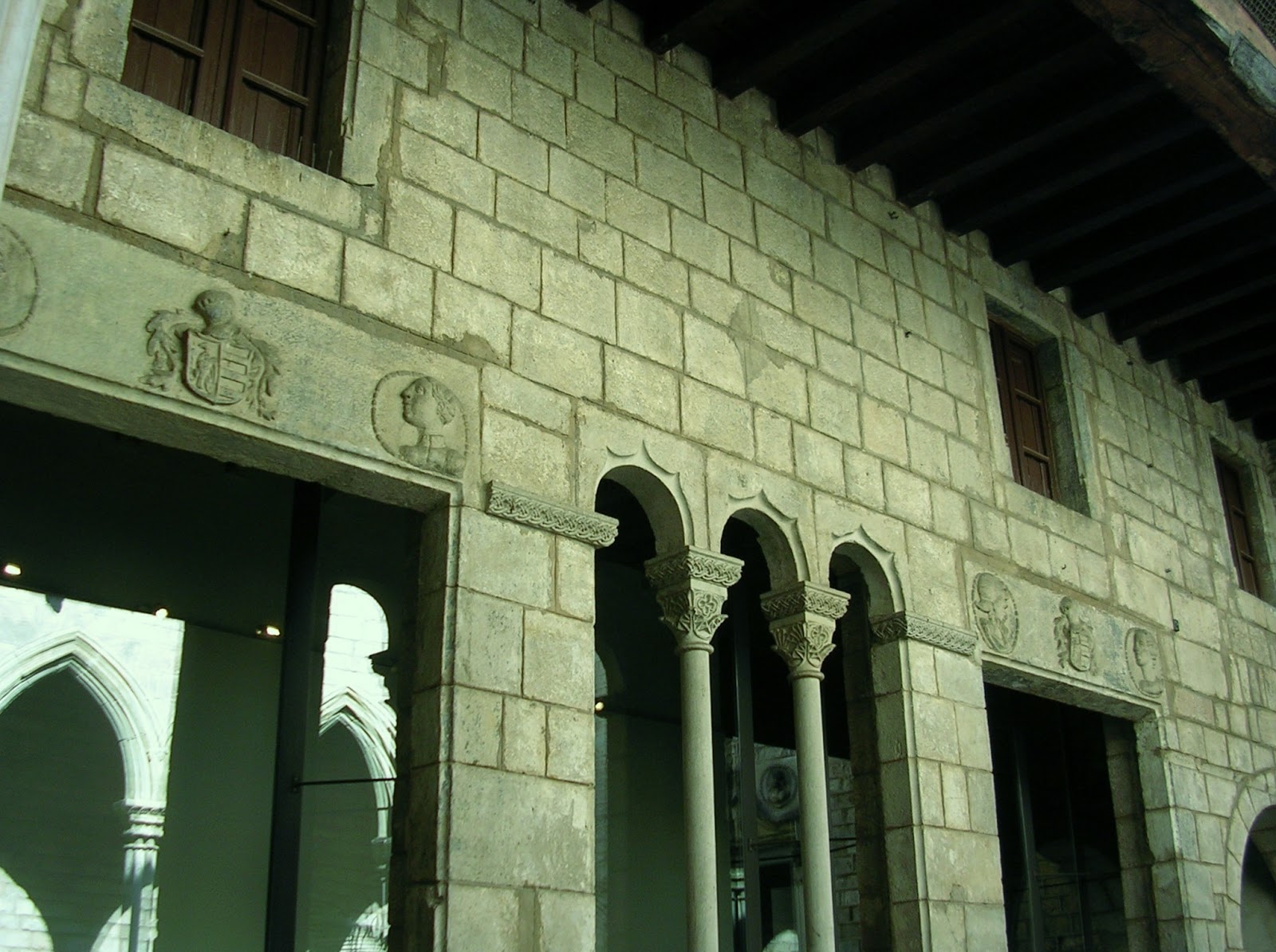 Picasso Museum, Barcelona. Moorish evolved into Renaissance in parts.
  Dedication, Pablo Picasso, at Museum, Barcelona
 Pablo Picasso Museum, Barcelona. Outdoor stairway connecting levels of the palaces comprising the mussr
 Galleon, Barcelona. Pinta-Nina-Santa Maria type. Christopher Columbus. .v
 Barcelona harbor, Christopher Columbus.
 Christopher Columbus: From whom came his education.
 Colom, Columbus, Colon. Original name, to later spellings, Christopher Columbus.
 Columbus, life of, Barcelona harbor.
 Columbus did no wrong. Barcelona harbor. Vet.
 Columbus, seeking financing? Barcelona harbor.
 Queen Isabella made Columbus' first dreams come true. Barcelona harbor.
  Dan Widing and Rosario. To life.
  Rosario the chef. Midday meal in Terrassa
 Rosario and her family photos, and Dan. Terassa, Spain.
 Rosario and Daniel Widing -- her visits to the US are great fun.
 Rosario and family; and Daniel Widing included. Terassa, Spain.